Testing the Frost and Deicing Salt Resistance of Natural Stone According to TL Pflaster-StB 06/15 in Combination with DIN EN 1367-6
Natural stone has been a preferred material in road and pavement construction for centuries, both for its visual quality and its durability. In exterior applications, resistance to frost and deicing salts is critical. Natural stone pavements are exposed to heavy stress during winter months: freeze-thaw cycles, moisture, and deicing salts attack the stones and can lead to cracking, spalling, and material loss over time. Standardized procedures exist to test the suitability of natural stone for these conditions. Of particular relevance are the Technical Delivery Conditions for Paving Stones (TL-Pflaster-StB 06/15) in combination with DIN EN 1367-6.
Basics of Frost and Deicing Salt Resistance
Frost and deicing salt resistance describes a material’s ability to withstand repeated freezing and thawing cycles in combination with chemical deicing salts. When water in the pores of the natural stone freezes, mechanical stresses arise. These stresses can be amplified by deicing salts, potentially causing micro- or macro-cracks. Stones with high density and low water absorption, such as granite or basalt, exhibit higher resistance, whereas porous stones like sandstone or limestone are more sensitive.
Testing this resistance is essential in road construction, as spalling or cracked natural stone not only causes visual defects but can also compromise the safety and load-bearing capacity of traffic surfaces.
Test Procedures Based on DIN EN 1367-6
DIN EN 1367-6 describes a standardized laboratory procedure for determining the frost and deicing salt resistance of aggregates. This procedure is also applied as a reference for natural stone testing. For evaluation, compressive strength is additionally measured on loaded and unloaded test specimens. These procedures are outlined and specified in TL-Pflaster-StB 06/15. The process is divided into several steps:
-
- Sample Preparation:
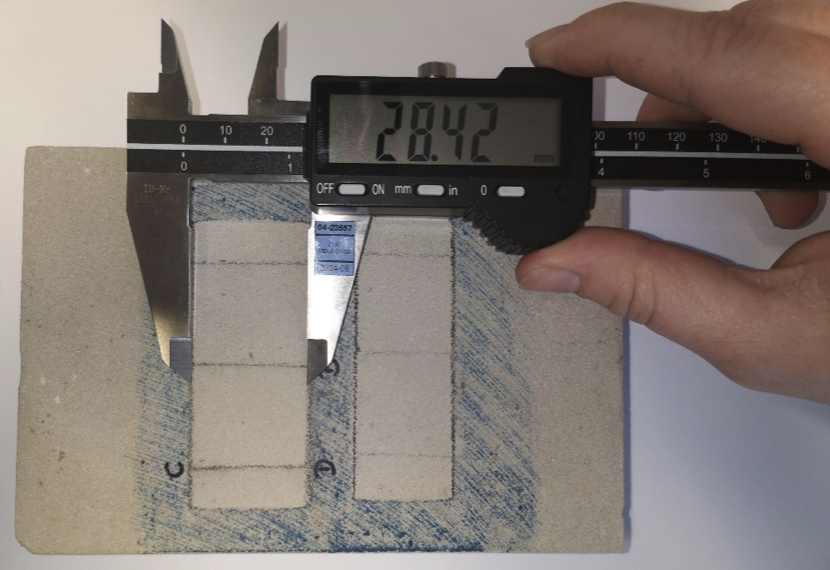
- Natural stone samples are prepared to standardized dimensions, cubes with an edge length of (50 or 70) + 5 mm.
- The initial masses of the samples are determined.
- Determination of Compressive Strength on Unloaded Samples:
- 10 natural stone samples are prepared according to DIN EN 1926 and their compressive strength determined.
- Preconditioning:
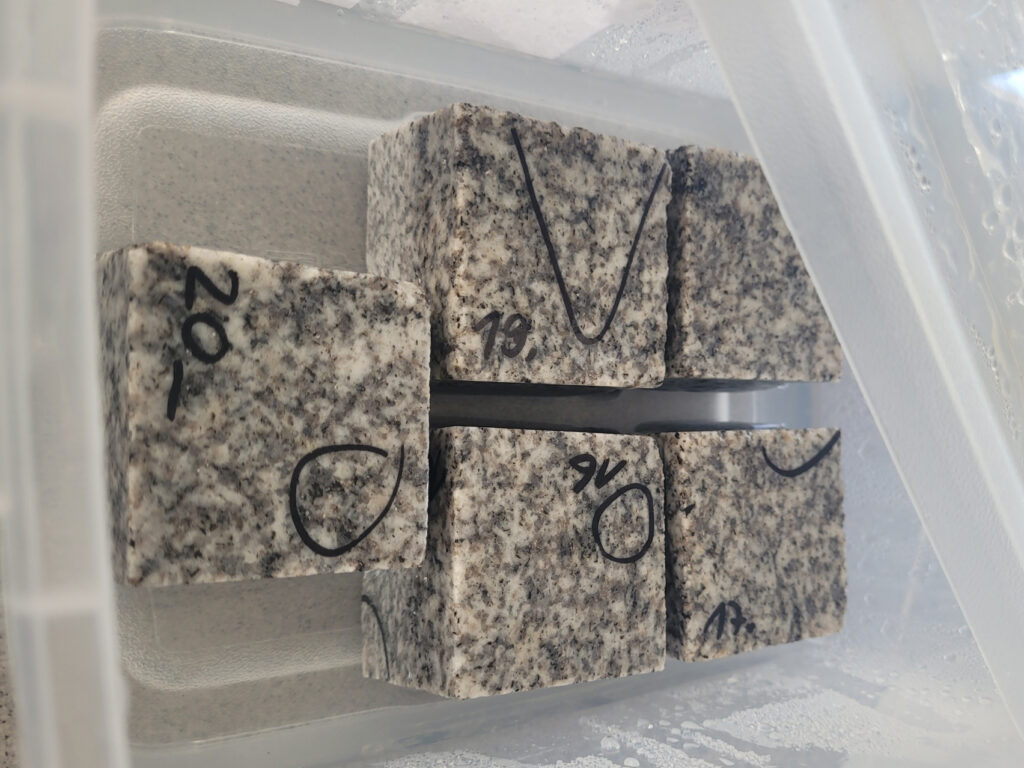
- Another 10 samples are stored for 24 hours in a 1% sodium chloride solution to saturate the pores with salt solution.
- Frost and Deicing Salt Cycles:
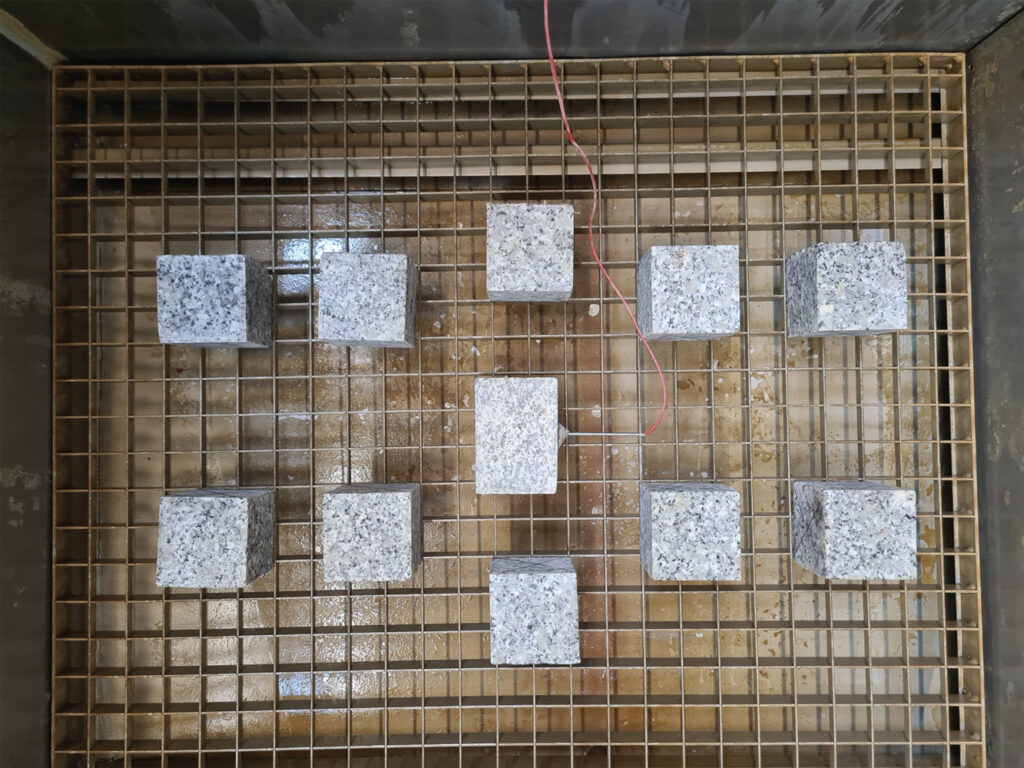
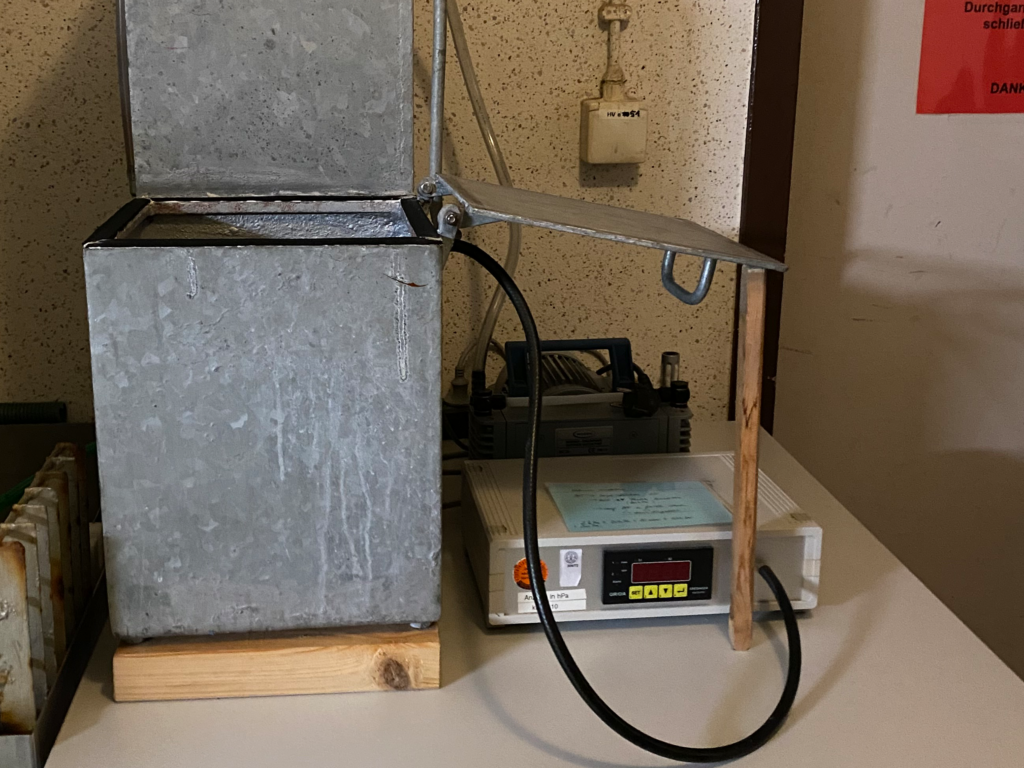
- The samples in the container with salt solution are frozen in a climate chamber to approx. -17.5 °C.
- Controlled thawing follows up to +20 °C.
- A total of 25 cycles are conducted.
- Testing and Evaluation:
- After 25 cycles, samples are examined for mass loss, cracking, spalling, surface changes, and compressive strength.
- Mass losses of more than 2 % in a maximum of one specimen or a change in compressive strength of more than 20 % are considered indicators of limited suitability. Exceeding these parameters requires separate verification of suitability.
This standardized procedure allows systematic comparison of different natural stone types and an objective assessment of their suitability for paving and slab applications.
Practical Significance
Testing according to TL-Pflaster-StB 06/15 and DIN EN 1367-6 is of critical importance for planners, construction companies, and manufacturers:
- Durability of pavements: Regular exposure to frost and deicing salts leads to increased maintenance without proper testing.
- Safety: Spalling natural stone can create trip hazards or other risks.
- Cost-effectiveness: Early classification of unsuitable stones prevents poor investments.
- Standards-compliant documentation: Owners are assured of the suitability of the natural stones used.
Further Information
More detailed content will follow in upcoming posts of the INFO Series on Natural Stone Testing.
If you have further questions or would like project-specific advice, please contact us at any time via our contact form or send a message to mail@besco-gmbh.de
. We will get back to you promptly.