Determination of slip resistance according to DIN EN 16165:2021
reading time - 7 min
Determination of slip resistance according to DIN EN 16165:2021
In the individual European member states, there have so far been a large number of different standards and regulations for determining slip-resistant properties. Often, the measurement principles differed only slightly, but had to be observed individually during testing and evaluation. As of December 2021, the new standard DIN EN 16165 has been published. With the title: “Determination of slip resistance of floors – Determination method; German version EN 16165:2021” we now have a European document at hand, which partially or completely replaces our previous national test standards DIN 51097, DIN 51130 and DIN 51131 for the determination of slip resistance properties. The new standard contains 4 test methods in annexes A to D, which describe the testing of the slip-resistant properties; however, it does not set requirements for the floor coverings. These are to be determined individually by the local conditions in the member states. Since this is a test standard, it is to be applied immediately and does not have a transition period like a product standard.
What has changed and what needs to be considered in the future?
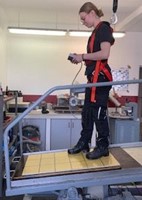
The most significant change for the test laboratories occurred with the “test by walking barefoot on an inclined plane” according to Annex A of DIN EN 16165 (old DIN 51097). After new standard pavements (reference pavements) had to be acquired for this test, the test persons were trained once on these new pavements. The standard surfaces are surfaces with a defined angle of slip, which are necessary for the “calibration” of the test persons. Provided the test persons prove to be suitable, they are allowed to perform the test. It is now clearly described that the test solution used for this purpose (water with a small amount of low-foaming non-ionic surfactant) must be used only once to avoid contamination by body fats/oils and should have a temperature of (29+2) °. The new standard describes in great detail the test procedure (e.g. step frequency and determination of the point of slip) and calculation of the test value. Another new feature is that, depending on the test value, the appropriate standard floor covering must also be walked on after each series of test floor coverings. This is necessary for the subsequent verification and correction procedure to determine the individual correction value.
Inclined plane
For the “test by footwear walking on an inclined plane” according to DIN EN 16165 Annex B (old DIN 51130), the standard coverings have been retained. However, the specified slip angles of these standard coverings have been somewhat adjusted on the basis of numerous round robin tests with the new standard. Shore hardness tests of the soles must now be performed regularly on the test shoes to be used, and the annual calibration of the inclined plane is now also part of the content of the standard.
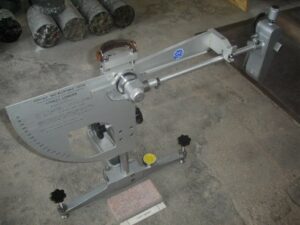
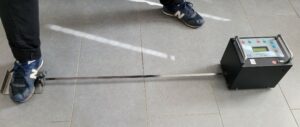
While the two aforementioned tests are purely laboratory tests, the tests according to Annexes C (pendulum test) and D (tribometer test, e.g. with the GMG 200) can be used as mobile tests in the laboratory and also on construction sites. In both tests, the type of reference plates has changed in the area of verification of the testing device before the test. Whereas in the previous standard solid materials were named, now only the requirements for the surface parameters are described.
Pendulum testTribometer testing (GMG 200)
The test of the displacement space V according to DIN 51130 no longer appears in the current set of standards. There is a draft of DIN 51133 dated December 2021: “Testing of floors – determination of displacement space”. It is currently unclear according to which standard testing is to be carried out.
What did we find out and what are the resulting implications?
Both the barefoot test according to Annex A and the test by footwear walking according to Annex B produce an angle in [°] degrees as the test result. Classification in classes as previously is not provided for in Europe. However, in the German version of the standard there is a national annex NB, from which the known classes of slip resistance can be taken. However, it is to be expected that test reports without classification into classes will appear.
The results of the pendulum and tribometer tests are given in the usual form. It is still not possible to convert these results into a class of slip resistance.
Even if the previous statements, particularly in the case of the tests on the inclined plane, may give rise to the suspicion that completely different test values are now being determined, the results according to the new and old set of standards can be described as equivalent. This means that existing test reports can continue to be recognized. Many test reports are nevertheless limited to 5 years. Then, due to new or changed manufacturing conditions, the tests should be updated.
Conclusion
In short, the new DIN EN 16165 is a comprehensive and meaningful document that offers us the opportunity to use uniform test methods on the European market and thus also to reduce trade barriers for construction products for use as floor coverings.
Our proven partner for many years – The Baustoffprüfstelle Wismar GmbH
The Baustoffprüfstelle Wismar GmbHwas founded in 1990 from the testing laboratory for building and heavy clay ceramics, which had already existed since the middle of the last century. In addition to the testing of ceramic building materials, the range of services now includes the certification of numerous other materials. Asphalt, concrete, natural stone and sand-lime bricks, among others, are also closely examined here.
In order to guarantee the quality and the required properties of belgrano® natural stone, BESCO Berliner Steincontor GmbH regularly commissions the accredited neutral testing laboratory. They are always on our side with advice, expertise and knowledge of the current testing standards. In this way, we are always up to date with current standards.
We would be happy to inform you about the latest topics and innovations relating to natural stone.
ARTICLES ABOUT THIS TOPIC
discover more articles on the topic -
technical information
Designing Accessible Stairways with belgrano® Natural Stone
reading time – 4 min
Following our articles on walkability and accessibility and on tactile guidance systems, the third part of our series on accessibility focuses on the specific requirements for staircases made of belgrano® natural stone.
The Core Parameters of Barrier-Free Surface Design: Tactile Guidance Systems with Natural Stone
reading time – 3 min
Accessibility in outdoor spaces begins with one essential principle: pathways must be easy, safe and intuitive to use, enabling everyone to move through public spaces independently and without unnecessary barriers. Following the first part of our technical series, "The Core Parameters of Barrier-Free Surface Design: Accessibility and Navigability with Natural Stone", this article focuses on tactile guidance systems.
The Core Parameters of Barrier-Free Surface Design: Accessibility and Navigability with Natural Stone
reading time – 8 min
Barrier free outdoor spaces are fundamentally about one thing: routes must be easy, safe and free from unnecessary obstacles. This applies to wheelchairs as well as pushchairs, bicycles, skateboards and everyday walking in later life. What matters most is a calm surface, a precise joint pattern and a design that supports movement in an intuitive way.
As part of our series on accessibility, this article looks at the technical parameters that allow designers to specifically improve the walkability and rollability of natural stone surfaces. Even the direction of the paving pattern can have a decisive impact on how comfortable a public space feels for users of mobility aids, pushchairs or other wheeled movement systems. When natural stone paving is laid in the direction of movement, rolling resistance is noticeably reduced. At the same time, impact from crossing joints is significantly minimised.
Natural Stone in Winter: Why belgrano® Withstands Frost and De-Icing Salts
reading time – 5 min
Hardly any season tests materials as rigorously as winter. The alternation of frost and thaw makes it clear that durability is no coincidence, but the result of the stone’s physical properties and precise surface treatment.
Petrographic testing and terminology of natural stone according to DIN EN 12407 and DIN EN 12670
reading time – 8 min
Petrographic analysis is, so to speak, the DNA or fingerprint of a natural stone. In this part of our INFO series on natural stone testing, we show how this test procedure works and what information it provides about the stone.
RStO 12/24: Changes to the guidelines for the standardization of the superstructure of traffic areas
reading time – 3 min
The Federal Ministry for Digital and Transport issued a new General Circular Road Construction No. 2/2024 on January 30, 2024. This concerns the guidelines for the standardization of the superstructure of traffic areas, 2012 edition, which are now available in the 2024 version (RStO 12/24).
Wir nutzen Cookies zur Optimierung dieser Website. Mit Ihrer Zustimmung verarbeiten wir Daten wie Surfverhalten und IDs. Ohne Zustimmung kann die Funktionalität eingeschränkt sein.
Funktional
Always active
Die technische Speicherung oder der Zugang ist unbedingt erforderlich für den rechtmäßigen Zweck, die Nutzung eines bestimmten Dienstes zu ermöglichen, der vom Teilnehmer oder Nutzer ausdrücklich gewünscht wird, oder für den alleinigen Zweck, die Übertragung einer Nachricht über ein elektronisches Kommunikationsnetz durchzuführen.
Präferenzen
Die technische Speicherung oder der Zugriff ist für den rechtmäßigen Zweck der Speicherung von Präferenzen erforderlich, die nicht vom Abonnenten oder Benutzer angefordert wurden.
Statistiken
Die technische Speicherung oder der Zugriff, der ausschließlich zu statistischen Zwecken erfolgt.Die technische Speicherung oder der Zugriff, der ausschließlich zu anonymen statistischen Zwecken verwendet wird. Ohne eine Vorladung, die freiwillige Zustimmung deines Internetdienstanbieters oder zusätzliche Aufzeichnungen von Dritten können die zu diesem Zweck gespeicherten oder abgerufenen Informationen allein in der Regel nicht dazu verwendet werden, dich zu identifizieren.
Marketing
Die technische Speicherung oder der Zugriff ist erforderlich, um Nutzerprofile zu erstellen, um Werbung zu versenden oder um den Nutzer auf einer Website oder über mehrere Websites hinweg zu ähnlichen Marketingzwecken zu verfolgen.